The integration of large language models (LLMs) into optical science is not merely an acceleration tool—it represents a foundational reconfiguration of experimental intelligence and knowledge synthesis. By moving beyond generic AI assistance, next-generation LLM frameworks—such as advanced retrieval-augmented generation (RAG), DeepSearch, and Agentic Context Engineering (ACE) —function as cognitive exoskeletons for scientists and engineers. They transform how we access, interpret, and operationalize the deep, often tacit knowledge embedded in decades of optical physics. Beyond knowledge synthesis, next-generation frameworks are now extending their reach to directly interface with laboratory hardware, turning high-level scientific goals into executable instrument control sequences.
This paradigm dismantles traditional knowledge silos. Experimental protocols, theoretical models, and hard-won tacit expertise—once confined to lab notebooks or expert intuition—are transformed into structured, instantly retrievable knowledge, continuously refined by self-improving agentic AI systems. The result is a fundamental shift: from isolated trial-and-error experimentation to systematic knowledge crystallization, dramatically accelerating discovery while rigorously preserving the first-principles physics that underpin precision optics. This evolution is exemplified by systems that not only retrieve and reason over literature but also actively orchestrate experimental workflows, enabling a new class of AI-driven laboratory copilots.
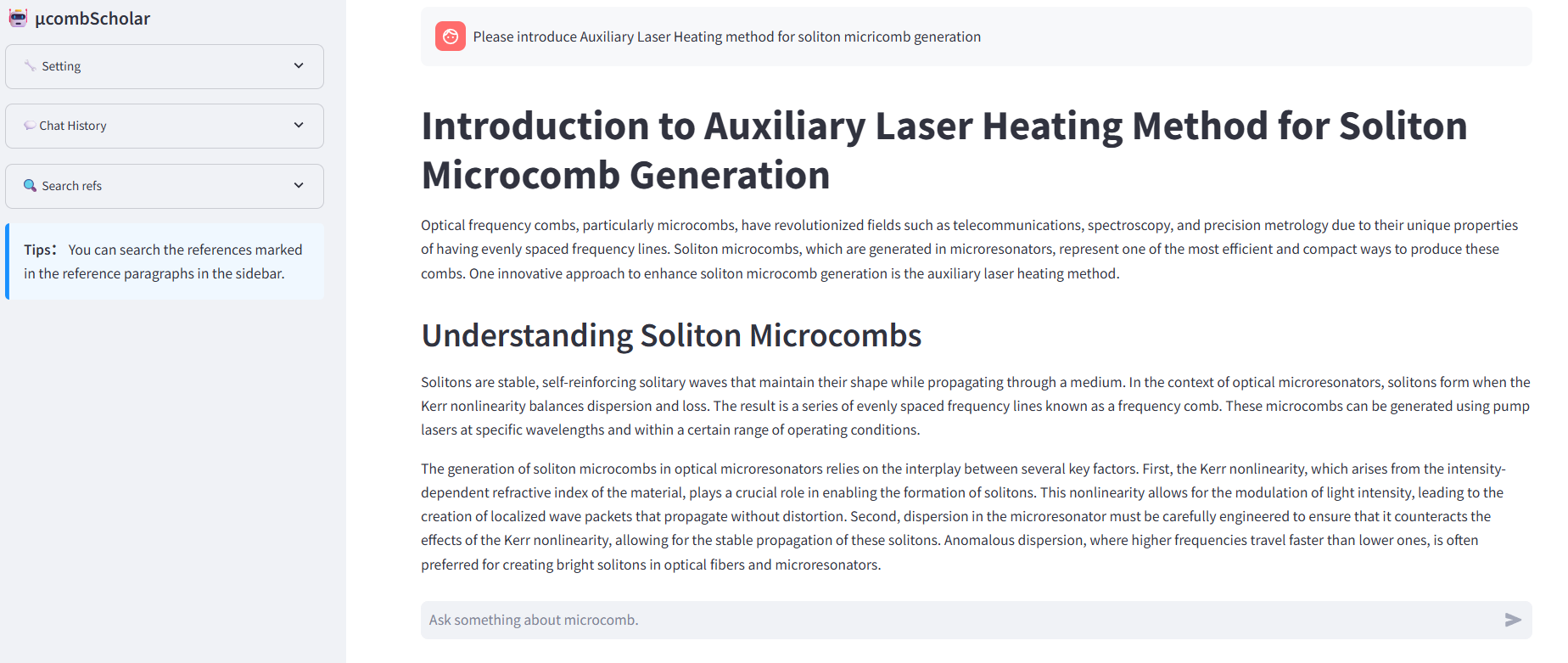
As an example, our μcomb Scholar embodies this vision: a domain-specialized LLM engineered exclusively for Kerr microresonator frequency comb research. Trained on a curated corpus of over 1,200 peer-reviewed publications and enriched with experimental logs, simulation datasets, and failure reports, it integrates RAG, Graph-RAG (GRAG), and Agentic AI framework —to enable dynamic, self-evolving reasoning. The system returns physically grounded, citation-traceable responses—not just summaries, but actionable design principles. In doing so, μcomb Scholar redefines the literature review: no longer a bottleneck, but a real-time discovery engine that accelerates the design–test–refine loop, while ensuring every suggestion respects the first-principles constraints of nonlinear optics. μcomb Scholar is available upon request.
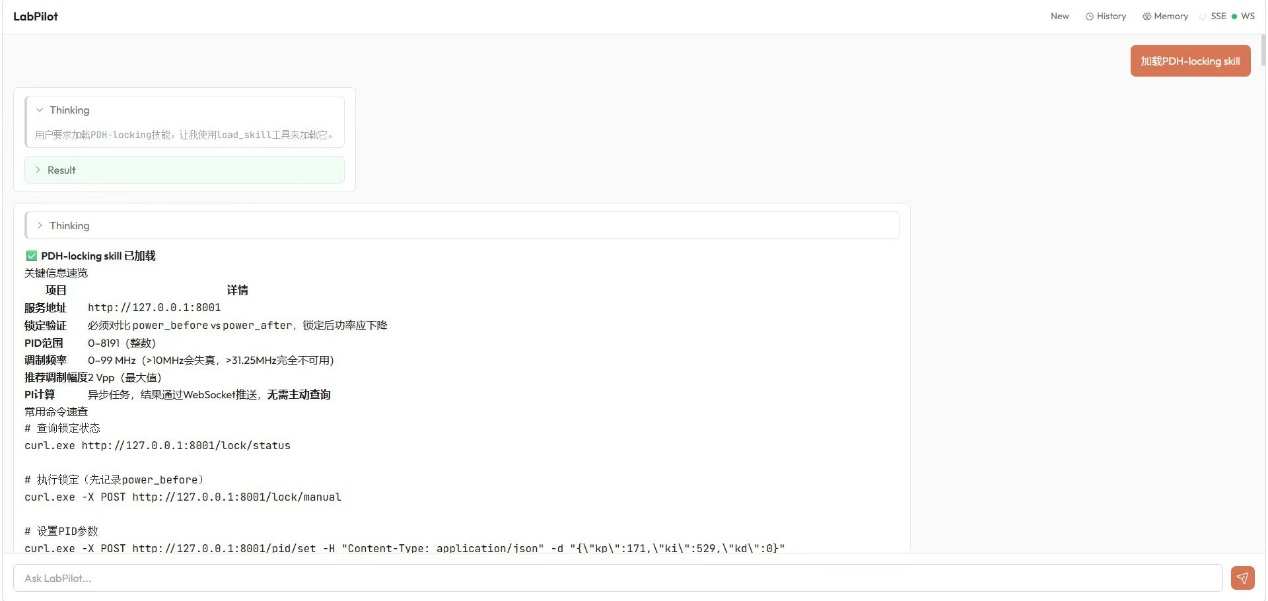
LabPilot is an open-source, AI-driven laboratory assistant framework engineered to bridge Large Language Models (LLMs) with physical experimental hardware in precision optics and photonics laboratories. By transitioning complex instruments and measurement protocols into agentic AI workflows, LabPilot enables autonomous control, real-time data ingestion, and closed-loop experiment optimization.
Currently, LabPilot supports specialized, agent-ready skills including PDH (Pound-Drever-Hall) locking and automated instrument control for advanced equipment like the Rohde & Schwarz Phase Noise Analyzer (PNA). This framework significantly lowers the barrier to executing high-precision measurements, shifting laboratory workflows from manual intervention to intelligent, natural-language-guided execution.
We are now learning, thinking, and developing more AI tools to empower cutting-edge optics research.